Tuesday, February 23, 2010

Day Four

After polishing off leftover oven roasted potatoes and chard from the other day, I decided I am tired of eating potatoes and greens!

So, I marched myself over to the co-op in search of a little variety. I came away with:

Michigan Beet Sugar, distributed by Lipari, 75 cents
Bur Oaks Farm old fashioned red popcorn, 50 cents
Apple Butter ,$4
Raspberry Jam ,$7 (steep!)
And some more Kale from Goetz Farm, in Riga, MI

After all that, I ended up only using the beet sugar!
I roasted my last Ida Red apple from Alex Nemeth's orchard in Ypsilanti with some dried cranberries, drizzled with beet sugar and honey from Lesser Farm in Chelsea. Delicious!

Monday, February 22, 2010

Day Three


Leftover local kale, apple, and cranberry salad from Day One along with bread from Avalon Bakery in Detroit for breakfast. I need to get some local preserves to spice it up a bit!

Also, last night I made myself a local bento (lunchbox) for today. It consisted of steamed rainbow chard (Riga, MI) and loads of oven roasted garlic and potatoes from Leroy, Michigan. Yum!

Day Two

Today was not a proud day for the Five-Finger Challenge.

Although I didn't have a full-fledged multi-ingredient local meal, I did have an Ida Red apple from Alex Nemeth's orchard in Ypsi for breakfast, so that counts as 100%, right?

I thought I might be able to eat local at the salad/hot bar at the food co-op, but the only labeled local-food I was able to include were the buckwheat sprouts (from Earthworks?).

I did spend some time whipping up a brew of kefir/tibicos though! I used kefir I bought from Mark from Thompson's Organic Creamery at the downtown farmers market this past weekend. For this batch I used sugar, lemons, blackstrap molasses, sodium bicarbonate, figs, and local pollen, but I'm hoping to transition into more local ingredients, like Michigan grown apricots or paw-paws.

Saturday, February 20, 2010

Day One

My shelf is in need of a food makeover.

Okay, the sour cream potato chips and Kit Kats aren't mine, but many shoppers with tight budgets might recognize that most of these products come from Aldi, a discount supermarket chain started in Europe known for no frills and low prices. Aldi is so cheap, you have to pay for grocery bags and make a deposit to use a shopping cart, so you'd better bring your bags and put the cart back where you got it from without relying on a store employee to do it for you. Also visible on this shelf is food purchased at Trader Joe's, owned by a family trust set up by one of the original owners of Aldi. Few of these products provide any information about where they are from.

None of these ingredients would do for my challenge, so I headed to the People's Food Co-op to see what was in season for my first day of local eating.

I was shocked to see how little variety I had in terms of Michigan products. The organic area of the produce section was lined with vegetables from California, Washington, Pennsylvania, and other states and countries.

These were my fresh, local produce choices: chard, kale, baby kale and mustard greens, apples, spinach, or potatoes. The spinach and baby greens were from Earthworks Farm, which is an amazing organization, but were priced well out of my budget. What has our food system come to when organic spinach from California is $3.99/lb, and from Detroit is over $4 for less than half a pound?

This is what I came away with:

Organic fingerling potatoes on "last chance sale" for 99 cents/lb from Tantre Farm (great find, but mischarged for $1.99/lb, should have been more careful!)
Conventional Jonathan and Ida Red apples grown by Alex Nemeth in Ypsilanti for .99/lb
A bunch of pesticide-free curly kale for $2.49 from Goetz Farm
A container of bulk organic dried Michigan cranberries for $5.87 (.45 lb)

What could I make out of this motley crew of ingredients?

I put together a fresh kale and apple salad with cranberries, ginger and apple cider vinegar, and also boiled and mashed the potatoes with some salt, canola oil, nutritional yeast and garlic my friend grew (Jeremy, you're a lifesaver!).

I also cooked up some Ann Arbor made tofu (no clue where the soy beans came from) I already had with canola oil, sage leaves, salt, and local bee pollen I happened to have in the fridge.

My thoughts on today? One, eventually replacing my cooking oils with local ones will not be easy. Only options I can think of at the moment are rapeseed/canola and sunflower oil, and both present their own challenges. On a more positive note: thank goodness for Michigan apples!


Michigan music today: Diana Ross

The Five-Finger Challenge

Being vegan has become too easy. That is, my decision not to eat any animal products was intended as something that would force me to make a conscious choice about everything I bought or put in my body. But after more than 4 years of veganism, my label-reading and purchasing choices have turned into a routine. I already know what brands and products I can buy at the grocery store, and exactly what I can order at nearly all the restaurants in town. I stopped caring about ingredients with names I can't pronounce, and even about shopping local in order to put food in my belly and make sure I can pay my rent. I have become a penny-pinching vegan robot.

But my friends, I am about to be reprogrammed. Starting today I have resolved to eat only local, seasonal foods. Sounds impossible, right? No salt, no pepper, no curry, no bananas, no olive oil? Not exactly. I'm going to start small, with one 90% local meal a day, and build from there. From my experience with a vegan diet, I know that this locavore imperative will only get easier. I propose for myself, and anyone else who wants to join me, the Five-Finger Challenge, named so because my "local" foods will be defined by having come from within the lower peninsula of Michigan, and everyone who's ever been to Michigan knows that us residents seem to associate our state and where we're from with the palm of our hand.

And so, the Five-Finger Challenge begins.

Sunday, July 12, 2009

Getting Dirty

I'll never forget the first time I found that Jim McDonald's earth, straw, and cob-loving friend from the Strawbale Studio in Oxford, Michigan was my middle school art teacher. Over the past week, I've had the chance to reconnect with Michigan's own natural builder extraordinaire Deanne Bednar. She taught me how to build little clay houses back in junior high, and she continues to teach about building houses with clay today.

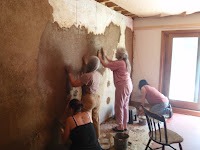
Deanne arranged a cob and earthen plaster workshop at Jim's house in order to share her valuable skills and help finish Jim's basement. Along with the assistance of one of her interns/WWOOFers, Deanne showed us how to test the clay content of the soil and filter it through screens to remove larger stones. Our project in particular involved earthen plaster on top of drywall. This basically means that we wanted to smear dirt with high amounts of clay and straw in it onto an ordinary wall, and make it into a new, more finished one. The earthen surface would function as plaster and insulation, while also creating a certain ambiance and warm, natural aesthetic.

Drywall, however, is a slippery surface to get mud to adhere to, so last week we had to create an adhesion coat. For this, we mixed flour and boiling water together to create a paste, which we added in proportion to our clay soil mixture and water.

This created gooey muddy deliciousness, which we smeared across the walls like fingerpaint. Deanne also fully encouraged playing with the mud, slapping and throwing it against the wall.

I met woman named Carol at the workshop, who is a farmer at the Kids' Cottage at Kensington Metropark. Not only is Carol amazing, but the facility and program she works with at Kensington is spectacular (Deanne helped design a cob and earthen plaster space for them there as well). Carol told me a story about someone saying to her about her work once "You think this job is nothing but fun!" Carol looked the person straight in the eye and said, "You're damn right I do!"

This week the adhesion coat was fully dry, and we were able to create a similar earthen plaste r mixture to use on the drywall and a cement wall, which needs no primer coat because of its more porous surface. We had a jolly time mixing the clay this time, as Deanne de monstrated for us how to dance around in the dirt and mix it with your feet. Who wouldn't be hooked after that?

The plaster felt very similar to the earlier mix, but needed to be applied with more care in order to be sure it would stick to the wall properly. We also smoothed the coat out with tools the create a nice finished surface. Jim will probably sculpt shelves, designs, or benches into the wall later on, all of which can be done with techniques like cobbing, earthen plaster, and/or hay bales. Below is an example of an example of a design from the Strawbale Studio.
Deanne invited me to attend the 2009 Natural Building Colloquium as an intern with her later this month--an amazing and generous opportunity! Unfortunately I can't go, but definitely check out all the great things going on there.

Friday, May 15, 2009

Avalon & Project Grow

Through a my friend Kris at the Southeastern MI Permaculture Guild, I got involved as a site coordinator in a community organic gardening project at Avalon Housing communities. Avalon has partnered with Project Grow the create Edible Avalon, a program that provides residents with everything they need to organically grow food and flowers, as well as a coordinator (or two) who help out with building, planting, watering, weeding, checking for pests and diseases, answering questions, and providing programming. I'm super pumped about my site, Parkhurst, because there are TONS of kids there, who seem even more excited than most of the adults. We are trying to arrange for the older kids to get a stand at the Ann Arbor Farmer's Market, and actually be able to sell what they grow.

At any rate, Kris, the project coordinator, said the garden was going to be along the side of the building, but we decided to change it to a sunny area at the center of the courtyard. The space on the side is still all set to go, and I'm hoping to fill it in with native wildflowers and see if I can't share some of the knowledge I pick up in my medicinal herbs class with the residents! At first I thought incorporating some kind of faerie theme would be cool, but that could be a bit much. Maybe a lot of kids don't dig that sort of thing? Hopefully, more on this later!